postal
postal
2009– time lapse vídeo 3′, apresentado no Festival Internacional de Linguagem Eletrônica, FILE, São Paulo.
2009– artigo intercom (link) apresentado no Congresso Brasileiro de Ciências da Comunicação, intercom, Paraná.
2010- 3’ time lapse video and a postcard, 15 x 10 cm, 500 copies available to the public, IAMCR – Conference Communication and Citizenship: rethinking and change, University of Minho, Braga, Portugal
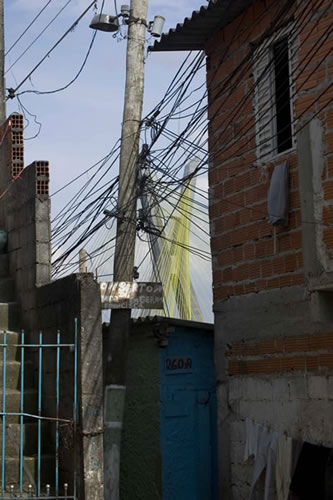
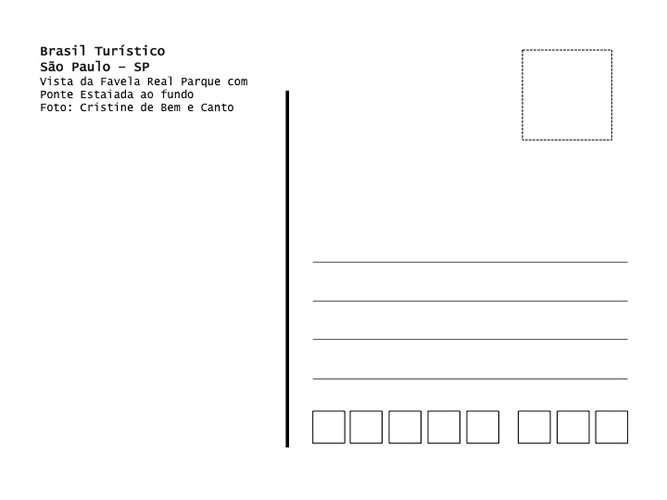
O trabalho postal apresenta uma vídeo-animação fotográfica e um cartão postal. O cartão mostra em primeiro plano, a favela do Real Parque, e, em segundo, a Ponte Estaiada, inaugurada em 2008, em São Paulo. As imagens da vídeo-animação foram tiradas por uma fotógrafa que atravessou o percurso proibido. e que ao cruzar a ponte, vivenciou um não caminho para o pedestre, no fim do outro lado, havia apenas a via para os carros.
Journalistic Information and Artistic Design: Two points of view regarding São Paulo’s ‘New Postcard Image’: the Support Bridge
Cristine de Bem e Canto, Brazil
abstract
Through analysis of the imagetic and text-based material of photographs used in the press as well as in the artistic field for the representation of the Support Bridge, two different readings can be recognized concerning the city of São Paulo’s new picture postcard image, located on the Marginal Pinheiros expressway. The Support Bridge, inaugurated in São Paulo in 2008, and which cost society millions of dollars, is presented from two points of view: the journalistic representation, set out in the press; and as a work of art. Comparing the journalistic and artistic images raises the issue of the relationship of photography with reality, whilst it can also be recognized that the photographic image testifies only to existence, but never to the meaning of a reality.
In analyzing the journalistic material, it can be seen that both the written text and the photographs presented in the material from Globo Online and the SPTV television program, focus in presenting the bridge as a grandiose project, lauding its decorative and technical characteristics. In the same manner, the photography published in the ‘Diario de São Paulo’ newspaper shows the bridge from a low angle, making it appear more grandiose than it actually is.
The artistic project entitled “Cartão Postal”, consisting of a video (3’) and a postcard, shows the bridge from a reflexive point of view, different to that published in the media. The project is made up of an animated photography video and a postcard which questions the social function of the Support Bridge – the representation of an excluding beauty. The video presents photographs taken by a photographer who crossed the bridge on foot despite this being prohibited. The photographs were animated later on and what can be seen in the video is a route which makes no provision for pedestrians, coming to an end in the middle of the road where the cars pass by. Completing the project, the postcard shows the “Real Parque” shanty town in the foreground with the Support Bridge behind it. In this photograph, details of the houses making up the Real Parque shanty town are highlighted in the foreground, as is a tangle of electrical wires which are blended with an image in the middle distance showing the yellow steel cables which support the bridge. The postcard which generally highlights a city’s tourist sights and its most beautiful buildings, in this case shows that which is being hidden away: the precariousness in which the inhabitants of the shanty town live. Therefore, as well as reflecting upon the photographic images and reality, what this text presents, by comparing journalistic and artistic images, is that the “Cartão Postal” artistic project provides an approach that is much more representative and encompassing in relation to the significance of the bridge for the city of São Paulo than that which has been published in the media. Since journalism presents itself as being responsible for the recording of happenings, offering them as profiles of the world, and declaring its discourse to be objective and clear, should it not then seek greater depth in the news.